
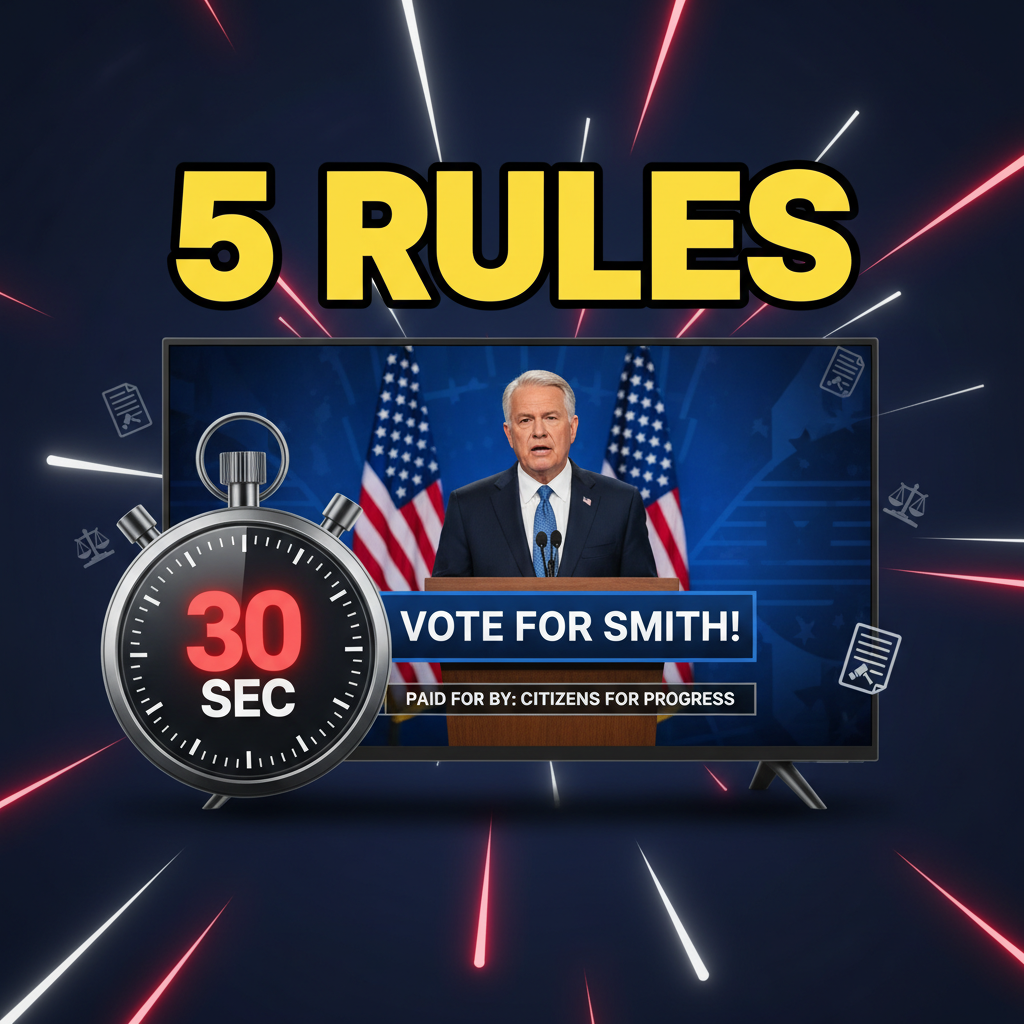
As political campaigns increasingly shift their advertising budgets toward streaming platforms, understanding the rules and best practices for political advertising on Connected TV (CTV) has never been more important. Whether you’re a political consultant, media buyer, or campaign manager, navigating the complex landscape of CTV political ads requires a clear understanding of creative length requirements, disclosure regulations, and platform-specific guidelines. This guide breaks down everything you need to know about political CTV advertising — from how long your ads should be to the five essential disclosure rules that every campaign must follow to stay compliant and credible.
What Is Political CTV Advertising?
Connected TV (CTV) advertising refers to video ads delivered through internet-connected television devices. These include smart TVs, streaming sticks like Roku and Amazon Fire, gaming consoles, and set-top boxes. Unlike traditional linear TV, CTV allows advertisers to target specific audiences with precision using data-driven strategies.
When it comes to politics, CTV has become a powerful channel. Political CTV advertising allows campaigns to reach voters who have cut the cord — meaning they no longer rely on cable or broadcast TV. With streaming audiences growing year after year, this is a segment that no serious political campaign can afford to ignore.
Political ads on CTV can appear on platforms like Hulu, Peacock, Tubi, Pluto TV, and many others that accept political content. Each platform has its own set of rules, but all are governed by broader federal and state-level regulations that campaigns must respect.
Why CTV Matters for Political Campaigns
The shift from traditional broadcast TV to streaming is dramatic. According to recent Nielsen data, streaming now accounts for more total TV viewing time than both broadcast and cable combined. This means that voters — especially younger demographics — are spending more time in front of streaming content than ever before.
Here are some key reasons why political campaigns are investing heavily in CTV:
- Precise audience targeting: CTV platforms allow campaigns to target voters by age, location, party affiliation, and even viewing behavior.
- Unskippable ad formats: Many CTV platforms offer non-skippable pre-roll or mid-roll ads, ensuring your message is fully delivered.
- Cord-cutter reach: CTV is the only way to reach households that have abandoned traditional cable or satellite TV.
- Cost efficiency: While CTV CPMs (cost per thousand impressions) can be higher than digital display, the quality of the audience and engagement rates often make it more cost-effective than linear TV.
- Measurability: Unlike traditional TV, CTV provides detailed analytics including completion rates, reach, frequency, and even voter file matching.
For modern political campaigns, CTV is not just an option — it is an essential part of any comprehensive media plan.
Creative Length for Political CTV Ads
One of the most frequently asked questions among political media buyers is: How long should a political CTV ad be? The answer depends on your campaign goals, platform requirements, and the message you’re trying to deliver.
Standard Creative Lengths
Most CTV platforms accept political ads in the following lengths:
- :15 (15 seconds): Best for brand awareness, name recognition, or simple attack messaging. Short enough to hold attention, but limited in depth.
- :30 (30 seconds): The most common and widely accepted format. Provides enough time to tell a story, make a compelling argument, and include all required disclosures.
- :60 (60 seconds): Ideal for issue-based ads or bio spots that require more context. Used strategically during key moments in a campaign cycle.
- :90 and 2:00+: Less common on CTV, but occasionally used for documentary-style content on platforms that allow longer formats.
Recommended Creative Length by Campaign Goal
- Name Recognition / Brand Awareness: :15 seconds — Keep it simple. Lead with the candidate’s name and a memorable visual or tagline.
- Persuasion / Issue Advocacy: :30 seconds — The sweet spot. Enough time to make an argument and drive an emotional connection.
- Contrast / Attack Ads: :30 seconds — Effective for quickly drawing distinctions between candidates without losing viewer attention.
- Bio Spots / Deep Introduction: :60 seconds — Helps audiences understand who a candidate is on a personal level, especially useful in primaries.
- Fundraising or GOTV (Get Out the Vote): :30 to :60 seconds — Calls to action benefit from slightly longer formats to give context and urgency.
Platform-Specific Length Requirements
Different streaming platforms have different technical requirements. Always check the specific platform’s ad specs before finalizing your creative:
- Hulu: Accepts :15, :30, and :60 second spots. Political ads must comply with Hulu’s political content policy.
- Roku (OneView): Accepts :15 and :30 second spots for most inventory.
- Peacock: Accepts :15, :30, and :60 second formats.
- Tubi and Pluto TV (FAST channels): Typically accept :30 second spots as the standard format.
- YouTube (CTV placements): Skippable ads (5 seconds before skip) can be any length; non-skippable bumper ads are limited to :06 seconds.
It is also worth noting that non-skippable ad formats are generally more effective for political messaging because voters cannot avoid your message. Many CTV platforms offer non-skippable inventory specifically for political campaigns, particularly during election season.
Best Practices for Political Advertising Creative on CTV
Beyond length, the quality and structure of your creative matter enormously. Here are key best practices to make your political CTV ads as effective as possible:
- Lead with your strongest message: You have only a few seconds to grab attention. Open with your most compelling visual or statement.
- Show the candidate early: Viewers should see and hear the candidate within the first 3–5 seconds when possible to build familiarity.
- Use clear, simple language: Streaming audiences are often multitasking. Avoid jargon and keep messaging straightforward.
- Optimize for sound-on viewing: Unlike social media, CTV ads are almost always watched with sound. Use strong voiceover and music strategically.
- Include a clear call to action (CTA): Whether it’s “Vote on November 5th” or “Visit [website] to learn more,” always close with direction.
- Ensure mobile-to-TV consistency: If you’re running the same creative across digital and CTV, make sure it translates well to a large screen.
- Test multiple versions: A/B testing different messaging or visuals can significantly improve performance over time.
5 Essential Disclosure Rules for Political CTV Advertising
Disclosure compliance is non-negotiable in political advertising. Failing to include proper disclosures can result in fines, platform rejection, and reputational damage. Here are the five essential disclosure rules every political campaign must follow when running CTV ads. – Political Geofencing: Polling Place 5 Essential Winning Tips
Rule 1: The “Paid For By” Disclaimer
Every political ad must include a clear statement identifying who paid for it. This is required under Federal Election Commission (FEC) regulations for federal campaigns and similar state-level rules for local and state races.
For CTV ads, the “Paid for by” disclaimer should:
- Appear as both an on-screen text overlay and a spoken audio disclaimer (depending on the platform and format).
- Name the specific committee or organization paying for the ad (e.g., “Paid for by Friends of Jane Smith”).
- Be clearly readable — sufficient font size, contrasting color, and enough on-screen time for a viewer to read it.
- Be present for ads run by both campaigns and outside groups (PACs, Super PACs, etc.).
Rule 2: Authorization Statement for Candidate-Authorized Ads
If a campaign has authorized the ad, the candidate must personally deliver a statement confirming this. You’ve heard this in traditional TV ads: “I’m [Candidate Name] and I approve this message.”
This rule applies to CTV ads as well. Key requirements include: (Learn more about political advertising)
- The candidate must appear in the ad either visually (on-screen) or via audio voiceover to deliver the approval statement.
- The statement must be “clear and conspicuous” — meaning it cannot be rushed, whispered, or buried at the end in a way that makes it difficult to understand.
- For ads produced by authorized committees (campaign committees), this statement is required by FEC law for federal races.
- State campaigns must check their respective state election board rules, as requirements vary by jurisdiction.
Rule 3: Clear and Conspicuous On-Screen Display
Simply including a disclaimer isn’t enough — it must be clearly visible and legible to the average viewer. The FEC has specific guidance on what “clear and conspicuous” means for video ads:
- Text must appear for at least 4 seconds on screen.
- Font size must be at least 4% of the screen height.
- There must be sufficient contrast between the text and background so the disclaimer is easily readable.
- The disclaimer cannot be placed in a location that viewers are likely to miss (e.g., extreme corners of the screen in tiny text).
Many campaigns make the mistake of treating disclosures as an afterthought. On CTV, where screen sizes and resolutions vary widely, it’s critical to test your creative on multiple devices to ensure the disclaimer remains visible and legible.
Rule 4: Disclosures for Independent Expenditure and Outside Group Ads
Ads run by Super PACs, 501(c)(4) organizations, and other outside groups face additional disclosure requirements. These entities are not campaigns themselves and must clearly differentiate their ads from candidate-authorized communications.
Key rules for outside group ads include:
- The ad must clearly state it was not authorized by any candidate or candidate committee: for example, “Not authorized by any candidate or candidate’s committee.”
- The name and address (or website) of the organization must be included.
- Both audio and visual disclosures are required for video ads, including CTV.
- Certain types of electioneering communications have reporting obligations within specific windows before an election.
Working with a compliance attorney or experienced political media buyer is strongly recommended for outside groups, as the rules in this area are complex and frequently litigated.
Rule 5: State and Local Disclosure Requirements
Federal FEC rules govern federal races (presidential, congressional), but state and local campaigns are subject to their own separate disclosure requirements — and these vary dramatically from state to state.
Some important points to keep in mind:
- Some states require disclosures in specific languages, particularly in jurisdictions with large non-English-speaking voter populations.
- Certain states mandate that the disclaimer include the name and address of the treasurer of the political committee.
- Some local jurisdictions have even stricter rules about font size, duration, and placement of on-screen disclosures.
- State rules also govern what constitutes an “electioneering communication” and which ads trigger disclosure requirements based on timing relative to the election.
Always consult your state election board’s published guidelines and work with a political compliance expert to ensure your CTV ads meet all local requirements in addition to federal standards. – Political OTT: Issue Ads — 5 Essential Rules to Master
Platform-Specific Guidelines for Political Advertising
Beyond legal requirements, each CTV platform has its own policies governing political advertising. Understanding these policies is critical for media buyers who want to avoid creative rejection or campaign delays.
Hulu
Hulu accepts political advertising but has strict content policies. Ads must not include content that Hulu deems hateful, harassing, or deceptive. All creative must be submitted for review, and campaigns should plan for a review window of several business days, especially during peak election periods.
Roku (OneView / The Roku Channel)
Roku’s OneView platform accepts political advertising through its programmatic buying platform. Campaigns must certify that their ads comply with all applicable laws, including FEC and state disclosure requirements. Roku reserves the right to reject ads that violate its content policies.
Peacock
NBCUniversal’s Peacock platform accepts political advertising with a robust vetting process. Political advertisers must be verified, and campaigns should expect to provide documentation including committee registration and FEC filings. (Learn more about political advertising)
Amazon Streaming TV (Fire TV / Prime Video)
Amazon has historically been selective about political advertising on its platforms. Campaigns should check current policies before planning buys, as Amazon’s stance on political content can change between election cycles.
FAST Channels (Tubi, Pluto TV, etc.)
Free Ad-Supported Streaming TV (FAST) channels have become an important inventory source for political campaigns due to their broad reach and more accessible CPMs. Most accept political advertising, but rules around disclosure and content must still be followed meticulously.
Compliance Tips for Media Buyers
For media buyers managing political CTV campaigns, compliance is an ongoing responsibility — not a one-time checklist. Here are actionable tips to keep your campaigns on the right side of the rules:
- Create a disclosure review process: Establish an internal review step specifically for verifying that all creative meets FEC and state-level disclosure requirements before submission.
- Work with a political compliance attorney: Especially for federal races and outside groups, the cost of legal advice is far lower than the cost of a compliance violation.
- Build disclosure review into your production timeline: Don’t treat compliance as an afterthought. Build it into the creative development process from day one.
- Keep documentation: Save all records of ad placements, targeting parameters, and creative approvals. Campaigns are required to maintain records for FEC reporting purposes.
- Monitor platform policy changes: CTV platforms update their political advertising policies frequently, particularly in the months leading up to an election. Stay current with platform-specific updates.
- Test creative across multiple devices: CTV is viewed on everything from 70-inch smart TVs to small Roku sticks. Make sure your disclosures are legible across all screen sizes and resolutions.
- Plan for platform review delays: During peak election season, platforms can be overwhelmed with ad submissions. Submit creative early to avoid missing your intended flight dates.
Measuring the Success of Your Political CTV Campaign
Running a compliant and well-produced political CTV ad is only part of the equation. Measuring performance is what separates effective media buyers from those who are flying blind.
Key Metrics to Track
- Video Completion Rate (VCR): The percentage of viewers who watch your ad to completion. A strong VCR for CTV political ads is typically above 85–90%.
- Reach and Frequency: How many unique voters saw your ad, and how often. Political campaigns typically aim for a frequency of 3–7 exposures per voter during a campaign window.
- Impressions by District or Geography: Especially important for down-ballot races where precise geographic targeting is essential.
- Voter File Match Rate: Many CTV platforms allow you to match impressions back to voter files to measure how many registered voters from your target universe were reached.
- Lift Studies: Brand lift or message recall studies can help campaigns understand whether their CTV ads are actually moving the needle on name recognition, favorability, or issue awareness.
Integrating CTV Data with Overall Campaign Strategy
The real power of CTV measurement comes when you integrate it with your broader voter contact strategy. By combining CTV reach data with polling, canvassing data, and digital ad performance, campaigns can build a comprehensive picture of how voters are engaging with their message across all touchpoints.
This kind of cross-channel attribution is one of the most exciting frontiers in modern political advertising, and CTV is at the center of it.
The Future of Political Advertising on CTV
The political advertising landscape on CTV is evolving rapidly. Here are some trends that are shaping the future of this channel:
- Addressable TV targeting: The ability to serve different ads to different households watching the same show is becoming more sophisticated, giving campaigns unprecedented targeting precision.
- AI-powered creative optimization: Artificial intelligence tools are increasingly being used to test and optimize ad creative in real time, improving performance throughout a campaign flight.
- Programmatic political buying: More political inventory is becoming available programmatically, giving campaigns greater flexibility and efficiency in how they buy CTV.
- Increased regulation: As CTV grows as a political advertising channel, expect increased regulatory scrutiny at both the federal and state levels. New disclosure requirements specific to digital and CTV formats are already being proposed in several states.
- Interactive and shoppable ad formats: While still nascent for political use, interactive CTV ad formats that allow viewers to learn more or take action directly from their TV screen represent an exciting frontier for campaign engagement.
Campaigns that invest now in understanding CTV’s full potential — including its compliance requirements — will be better positioned to leverage these emerging capabilities as they mature.
Conclusion
Political CTV advertising represents one of the most powerful and precise tools available to modern campaigns. But with great reach comes great responsibility. Understanding creative length best practices and adhering to the five essential disclosure rules are not just legal requirements — they are fundamental to running an ethical, credible, and effective political ad campaign.
Whether you’re a seasoned political media buyer or new to the world of streaming advertising, staying informed about platform requirements, FEC guidelines, and state-level disclosure rules is essential. The campaigns that win are the ones that combine compelling creative with airtight compliance — and CTV is the channel where both matter most.
As you plan your next political advertising campaign, make CTV a cornerstone of your media mix. Invest in quality creative, build disclosure review into your workflow, and work with trusted partners who understand both the art and the regulation of political CTV. The voters are watching — make sure your message reaches them the right way.