
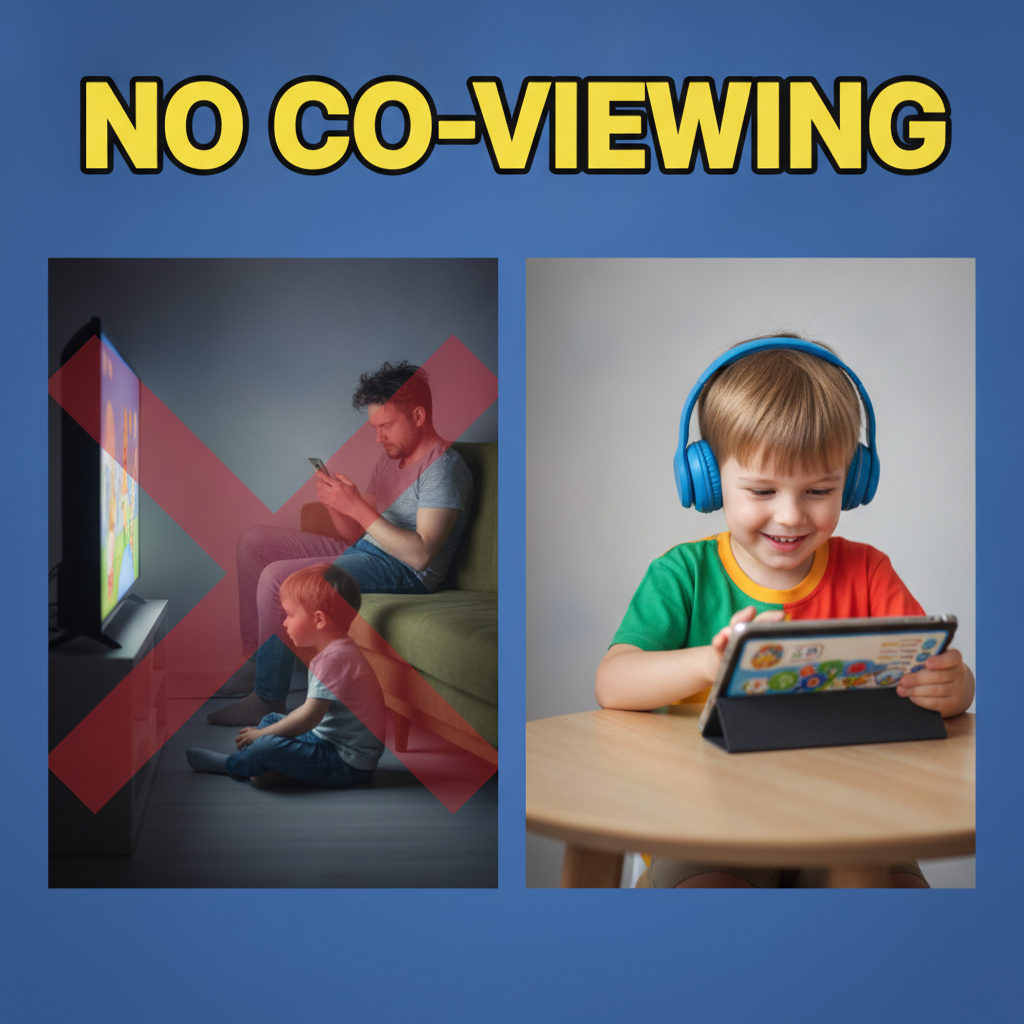
In today’s data-driven advertising landscape, co-viewing has become one of the most talked-about — and most misunderstood — challenges in media buying. Co-viewing refers to the phenomenon where multiple people watch the same screen simultaneously, yet only one person is counted as the viewer.
For media buyers and advertisers, this creates significant gaps in audience measurement, targeting accuracy, and return on investment. Whether you’re running campaigns on connected TV (CTV), streaming platforms, or traditional linear television, understanding co-viewing and learning how to account for it in your strategy can mean the difference between a campaign that truly resonates and one that misses the mark entirely. This guide breaks down everything you need to know about co-viewing in plain language — and gives you five proven tips to handle it like a pro.
What Is Co-Viewing? A Clear Definition
Co-viewing is simply what happens when more than one person watches content on a single screen at the same time. Think about a family sitting together on a Friday night watching a movie on their smart TV. The streaming service logs one account, one user profile — but in reality, four or five people are watching the same ad. That’s co-viewing in action.
The concept is not new. In the early days of television, Nielsen ratings always accounted for multiple viewers per household. But as the industry shifted toward digital and programmatic advertising, measurement methodologies became more individualized — often logging device or account-level data, not actual people in the room.
Co-viewing is especially common in the following settings:
- Family households watching evening programming together
- Couples or roommates sharing a streaming subscription
- Sports viewers gathering around a big screen for live events
- Holiday or seasonal content watched as a group activity
- Children’s content where parents watch alongside kids
Understanding the basic definition is the first step. But to truly grasp why co-viewing matters, you need to understand how it interacts with modern media buying strategies.
Why Co-Viewing Matters in Media Buying
Media buyers are paid to make smart decisions about where, when, and how ad dollars get spent. Every dollar needs to reach the right audience, at the right time, with the right message. Co-viewing disrupts this precision in ways that many advertisers are still catching up to understand.
When you buy ad inventory on a CTV platform, you’re typically paying based on the number of users or households your ad reaches. But if co-viewing means that three people watched every ad in your campaign — instead of just one — your actual reach could be dramatically higher than what’s reported. That sounds like good news, but it also means your targeting might be off.
Here’s why co-viewing is a critical issue for media buyers:
- Reach is underreported: Your campaign may be reaching far more people than the data shows.
- Audience composition is unclear: You might be targeting a 35-year-old male, but his entire family is watching the ad.
- Frequency calculations are skewed: Ad frequency caps set at the account level may expose some viewers to far too many ads.
- Attribution becomes murky: When multiple people see an ad, tracking which viewer drove a conversion becomes nearly impossible without the right tools.
- CPM pricing may not reflect true value: If actual viewership is higher than reported, you may be getting more — or less — value than you think.
These are not minor inconveniences. They’re fundamental measurement gaps that can cost brands thousands or even millions of dollars in misallocated ad spend.
Co-Viewing on CTV and Streaming Platforms
Connected TV (CTV) has exploded in popularity over the last five years. Platforms like Roku, Amazon Fire TV, Apple TV, and smart TVs from Samsung and LG have made streaming the default entertainment choice for millions of households. And with that growth, co-viewing on CTV has become one of the industry’s most pressing measurement challenges.
Unlike desktop or mobile devices — which are typically used by one person at a time — a television is inherently a shared screen. It sits in the living room, the bedroom, or the kitchen, and it’s watched by whoever is present. This fundamentally changes how we should think about audience measurement on these platforms.
Research from industry groups consistently shows that co-viewing rates on CTV are significant:
- Studies suggest that anywhere from 2 to 3.5 people may be watching a single CTV session on average
- Co-viewing rates are highest during primetime hours (7 PM – 11 PM)
- Live sports and tentpole events have some of the highest co-viewing rates of any content category
- Households with children tend to have more frequent co-viewing sessions than adult-only households
Streaming platforms typically authenticate users at the account level. This means they know who has a subscription, but they don’t necessarily know who is in the room watching. Single sign-on creates a major blind spot in audience data, especially when multiple profiles exist under one account but only one profile is active during a session.
Some platforms are beginning to introduce viewer-level data signals — such as interactive ad formats or on-screen confirmations — to try to identify who’s actually watching. But this technology is still evolving, and widespread adoption remains years away for many publishers. – November Digital Advertising Trends: Preparing for the Festive Season
The Measurement Challenges of Co-Viewing
If you’re a media buyer trying to plan a campaign with precision, co-viewing creates some serious headaches on the measurement side. Let’s walk through the biggest challenges you’ll face.
1. Device-Level vs. Person-Level Data
Most digital ad platforms — including CTV — measure at the device or account level. This means your data tells you how many devices played an ad, not how many human beings actually watched it. Without a way to differentiate between the two, you’re essentially working with incomplete data.
2. Cross-Platform Attribution
When a viewer sees an ad on a CTV screen, then later searches on a mobile device and makes a purchase, connecting those two events is already complex. Add co-viewing into the mix — where multiple people could have seen the same ad — and attribution modeling becomes exponentially harder. Was it the account holder who converted? A household member? There’s often no way to know.
3. Frequency Capping Failures
Frequency caps are designed to prevent a single viewer from seeing the same ad too many times. But when frequency is tracked at the device level and multiple people share that device, some viewers might see an ad only once while others see it a dozen times. Over-frequency leads to ad fatigue and brand irritation — the exact opposite of what advertisers want to achieve. (Learn more about co-viewing)
4. Audience Segment Misalignment
Programmatic buying relies on audience segments built from behavioral and demographic data. If a household’s account is registered to a 45-year-old parent but the primary viewer during a session is a 16-year-old, your carefully crafted targeting parameters are meaningless. The ad is reaching someone outside your intended audience, and you may not even know it.
How Co-Viewing Impacts Ad Targeting and ROI
The downstream effect of all these measurement challenges is a direct hit to your campaign’s targeting efficiency and return on investment (ROI). Here’s how that plays out in practical terms.
Let’s say you’re running a campaign for a luxury automotive brand. Your target audience is adults aged 35–55 with household incomes above $100,000. You’re buying CTV inventory based on audience segments that reflect this profile. But if the households in your targeting set have multiple viewers per session — including teenagers, young adults, or elderly relatives — a significant portion of your impressions are landing with people who will never buy a luxury vehicle.
This is what media buyers call audience waste. And co-viewing is one of the biggest — and most overlooked — drivers of audience waste in modern advertising.
Additionally, when reach is underreported due to co-viewing, your campaign’s effective CPM (eCPM) may actually be lower than you think. If you’re paying for 1 million impressions but those impressions were actually seen by 2.5 million people, your cost per actual person reached drops — which is great. But if you’re not accounting for this in your reporting, you may be making budget decisions based on inaccurate data.
5 Proven Tips to Handle Co-Viewing in Your Media Strategy
Now that you understand the problem, let’s get to the solutions. Here are five proven, actionable tips that media buyers can use right now to account for co-viewing and improve campaign performance.
Tip 1: Apply Co-Viewing Multipliers to Your Reach Estimates
The simplest way to start accounting for co-viewing is to adjust your reach estimates using co-viewing multipliers. Industry research from organizations like Nielsen, Comscore, and various DSP partners has established average co-viewing rates by content category, daypart, and platform. Use these benchmarks to apply a multiplier to your projected reach.
For example, if you’re running a primetime CTV campaign and research suggests an average co-viewing rate of 2.3 viewers per session, multiply your reported impression count by 2.3 to get a more realistic estimate of actual human reach. This won’t be perfect, but it’s far more accurate than assuming a 1:1 ratio of impressions to viewers.
- Check your DSP or measurement partner for available co-viewing data
- Use content category benchmarks (sports vs. drama vs. news all have different co-viewing rates)
- Update your media plan templates to include co-viewing-adjusted reach columns
Tip 2: Prioritize Contextual Targeting Over Individual Targeting
When audience-level data is unreliable due to co-viewing, contextual targeting becomes your best friend. Instead of trying to reach a specific person based on their behavioral data, you target based on the content environment. If your product appeals to sports fans, advertise in sports content. If you’re marketing family products, buy inventory in family programming.
Contextual targeting is also increasingly relevant in a post-cookie, privacy-first world. It doesn’t rely on individual tracking — making it inherently more resilient to co-viewing’s measurement challenges while also aligning with evolving privacy regulations. – Home
- Work with publishers who offer strong contextual targeting capabilities
- Use content genre, topic, and daypart as primary targeting signals
- Pair contextual with broader household-level demographic data for better precision
Tip 3: Use Household-Level Measurement Solutions
Rather than fighting co-viewing, some advertisers have shifted to household-level measurement as their primary lens for evaluating CTV campaign performance. This approach accepts that a TV is a shared screen and measures success at the household level instead of the individual level.
Platforms like LiveRamp, Experian, and various CTV-specific measurement providers offer household identity graphs that can help you track campaign exposure and downstream actions (like website visits or purchases) at the household level. This won’t tell you which individual in the household responded to your ad, but it gives you a more honest and actionable view of campaign reach and effectiveness.
- Explore household identity solutions from measurement vendors
- Set KPIs that are household-based rather than person-based for CTV campaigns
- Align your attribution models to reflect household-level conversion paths
Tip 4: Leverage Interactive Ad Formats to Identify Individual Viewers
Some forward-thinking publishers and technology providers are tackling co-viewing head-on by introducing interactive or engagement-based ad formats that require viewer interaction. These formats — such as QR code ads, second-screen companion ads, or interactive overlays — generate viewer-level signals that can help distinguish individual viewers from the household aggregate.
When a viewer scans a QR code with their personal smartphone, for instance, you suddenly have a device-level signal tied to that specific individual. This is not a perfect solution — engagement rates vary, and not every viewer will interact — but it’s one of the most promising emerging techniques for piercing through the co-viewing veil. (Learn more about co-viewing)
- Request QR code-enabled creative formats from your publishers
- Build second-screen landing experiences optimized for mobile to capitalize on co-viewer interactions
- Track and analyze engagement rates as a proxy for individual-level reach
Tip 5: Incorporate Co-Viewing Data into Your Media Mix Modeling
For larger advertisers running multi-channel campaigns, media mix modeling (MMM) is the gold standard for understanding how each channel contributes to overall business outcomes. But most MMM implementations don’t account for co-viewing — which means the true contribution of CTV and linear TV to your results may be systematically undervalued.
Work with your analytics team or measurement partner to incorporate co-viewing adjustments into your MMM inputs. This means feeding in co-viewing-adjusted reach and impression data rather than raw platform-reported numbers. The result will be a more accurate picture of TV’s contribution to your funnel — and better budget allocation decisions going forward.
- Audit your current MMM inputs to check whether co-viewing is accounted for
- Partner with measurement vendors who can provide co-viewing-adjusted data feeds
- Revisit your channel attribution weights after incorporating co-viewing adjustments
Tools and Solutions for Co-Viewing Measurement
The good news is that the ad tech industry is actively developing tools to address co-viewing. Here’s a snapshot of the current landscape of solutions available to media buyers.
Nielsen ONE
Nielsen ONE is Nielsen’s unified measurement platform designed to provide cross-media audience measurement that accounts for co-viewing. It aims to reconcile person-level and household-level data across linear TV, CTV, and digital platforms — giving advertisers a more complete picture of actual audience exposure.
Comscore Campaign Ratings
Comscore offers campaign measurement solutions that include co-viewing adjustments for television and CTV campaigns. Their methodology uses panel data and statistical modeling to estimate actual person-level reach, even when device-level data is all that’s available.
iSpot.tv
iSpot.tv has emerged as a major player in TV ad measurement, offering real-time impression measurement that accounts for household-level co-viewing. Their platform provides advertisers with verified impression data across both linear and streaming TV, with demographic reach estimates that incorporate co-viewing behavior.
Samba TV
Samba TV collects automatic content recognition (ACR) data from smart TVs to provide deterministic viewership data at the household level. While it still doesn’t identify individual co-viewers, it provides much richer and more accurate household-level data than traditional digital tracking methods.
DSP-Level Co-Viewing Reporting
Major demand-side platforms (DSPs) including The Trade Desk and DV360 are increasingly incorporating co-viewing rate data into their reporting dashboards. Check with your DSP representative to understand what co-viewing signals are available within your current buying environment.
The Future of Co-Viewing in Advertising
The conversation around co-viewing is only going to get louder as CTV continues to grow. Industry forecasts suggest that CTV ad spending will continue to climb year over year, which means more advertising dollars are flowing into an environment where co-viewing is the norm, not the exception.
Several trends are likely to shape how the industry handles co-viewing in the coming years:
- AI-powered viewer detection: Some smart TV manufacturers are exploring camera-based or audio-based AI tools that can estimate how many people are in a room watching TV. Privacy concerns will need to be carefully navigated, but the technology is advancing quickly.
- Platform-level profile switching prompts: Netflix and Disney+ already prompt users to select a profile before watching. As this becomes standard practice across more platforms, it will generate better individual-level data that can help address co-viewing gaps.
- Universal identity solutions: As the industry works toward privacy-safe identity frameworks, some solutions may eventually enable better individual-level measurement on shared screens without requiring intrusive tracking.
- Standardized co-viewing metrics: Industry bodies like the IAB and MRC are working toward standardized guidelines for co-viewing measurement. When these standards are established, they’ll create a more consistent and reliable basis for media buying decisions.
The bottom line is that co-viewing is not a problem that’s going away. It’s a structural feature of how people consume television content — and it always will be. The media buyers who thrive will be those who embrace this reality and build their strategies around it rather than ignoring it.
Conclusion
Co-viewing is one of the most important yet underappreciated concepts in modern media buying. It affects how you measure reach, how you target audiences, how you manage frequency, and how you calculate ROI. Ignoring it means making decisions based on incomplete data — and in a world where every ad dollar counts, that’s a risk no serious media buyer should take.
By understanding what co-viewing is, why it matters, and how to account for it in your strategy, you can make smarter buying decisions, get more accurate performance data, and ultimately deliver better results for your clients or brand. The five proven tips outlined in this guide — applying co-viewing multipliers, embracing contextual targeting, using household-level measurement, leveraging interactive ad formats, and incorporating co-viewing data into your media mix modeling — give you a practical roadmap to start improving your approach today.
The advertising industry is evolving fast, and co-viewing will continue to be at the center of major discussions around measurement, accountability, and effectiveness. The time to get ahead of it is now. Use the information in this guide to start having more informed conversations with your platform partners, measurement vendors, and clients — and to build campaigns that reflect the reality of how people actually watch TV.