
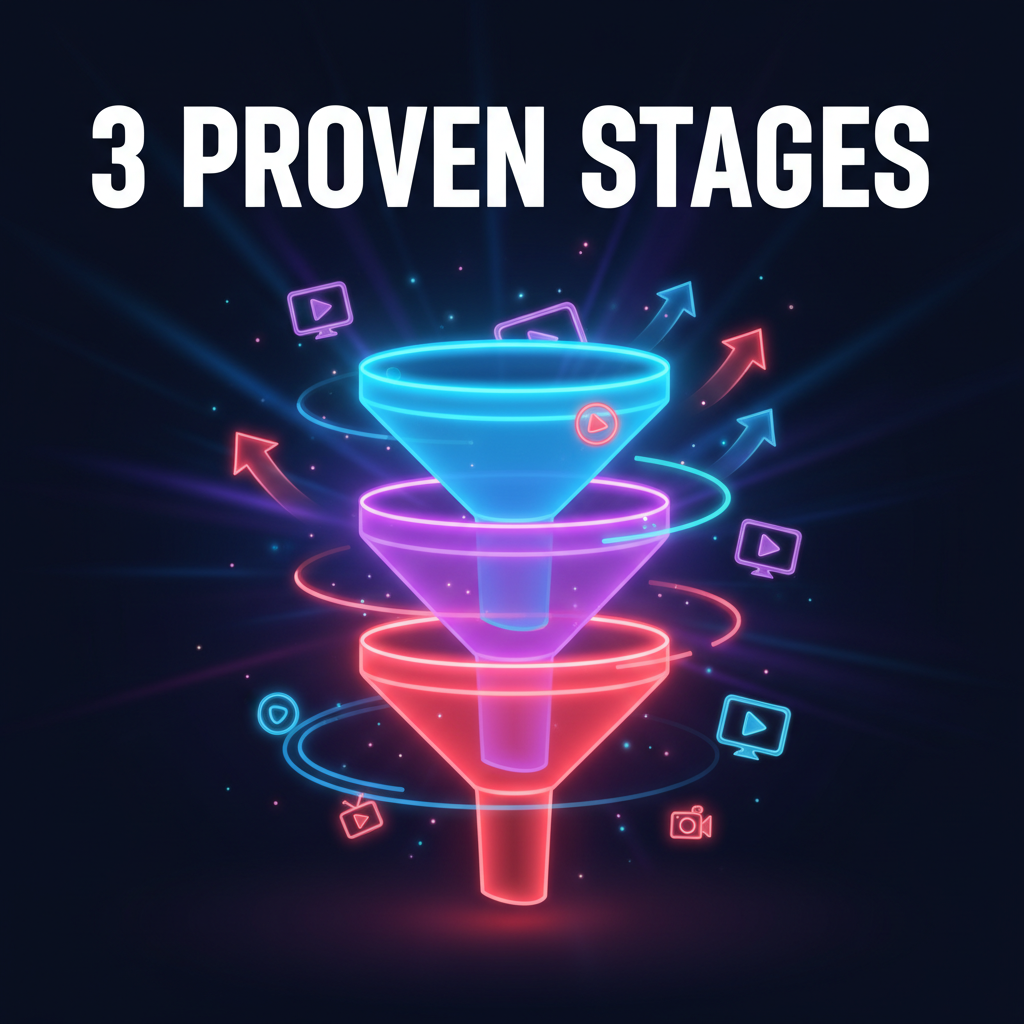
In today’s fast-paced digital advertising landscape, Online Video (OLV) has emerged as one of the most powerful tools in a media buyer’s arsenal. Whether you’re running pre-roll ads on YouTube, mid-roll placements on premium publishers, or short-form video across programmatic exchanges, OLV offers unmatched versatility across every stage of the marketing funnel. But here’s the challenge most advertisers face: they treat OLV as a one-size-fits-all solution, blasting the same video creative to the same audiences regardless of where those consumers are in their buying journey.
The result? Wasted impressions, poor performance metrics, and budgets that disappear without delivering meaningful ROI. This article breaks down the three proven stages of using OLV strategically in the funnel — and how to maximize your results at each one.
What Is OLV and Why Does It Matter in Media Buying?
OLV, or Online Video advertising, refers to video ad placements that appear across digital platforms — from streaming services and social media to news websites and mobile apps. Unlike traditional TV advertising, OLV is data-driven, highly targetable, and measurable in real time. It allows advertisers to deliver the right message to the right person at precisely the right moment.
OLV formats include a wide range of placements:
- Pre-roll ads — video ads that play before content
- Mid-roll ads — ads inserted during longer content pieces
- Post-roll ads — ads that appear after content finishes
- Outstream video — ads that appear within article content, outside of a video player
- Connected TV (CTV) and OTT placements — ads served on streaming devices and smart TVs
- Social video ads — short-form and long-form ads on platforms like YouTube, Meta, and TikTok
Media buyers love OLV because it combines the emotional storytelling power of television with the precision targeting of digital. It’s not just about reach — it’s about relevant reach. And when used strategically across the funnel, OLV becomes one of the highest-performing channels in your entire media mix.
Understanding the Full Funnel Approach in Digital Advertising
Before diving into OLV-specific strategies, it’s important to understand what a “full funnel” approach actually means. The marketing funnel is a framework that describes the stages a consumer goes through before making a purchase decision.
At its core, the funnel has three main layers:
- Upper Funnel (Awareness) — The consumer doesn’t know your brand or product yet. Your goal is to introduce yourself and make a memorable first impression.
- Mid Funnel (Consideration) — The consumer is aware of your brand and is actively evaluating options. Your goal is to educate, build trust, and encourage deeper engagement.
- Lower Funnel (Conversion) — The consumer is ready to act. Your goal is to remove barriers, reinforce value, and drive the final decision.
Each stage requires a different mindset, different creative, different targeting tactics, and different success metrics. The biggest mistake advertisers make is using the same OLV campaign approach for all three stages. Let’s break each one down in detail.
Stage 1: OLV for Upper Funnel Awareness — Making a Powerful First Impression
The upper funnel is all about reach, frequency, and brand storytelling. At this stage, your audience may have never heard of your brand. They’re not looking for you — they’re consuming content and going about their day. Your job is to interrupt that journey in a compelling, memorable way.
Goals at the Awareness Stage
- Build brand recognition and recall
- Reach the broadest relevant audience possible
- Create positive brand associations
- Drive video completion rates (VCR) and view-through metrics
Best OLV Formats for Awareness
For upper funnel campaigns, longer-form video tends to perform well — particularly 15-second to 30-second non-skippable or skippable ads. Connected TV (CTV) placements are also exceptional here because viewers are in a lean-back, engaged mindset.
YouTube’s TrueView In-Stream and Bumper Ads (6-second) are excellent choices for awareness campaigns, offering wide reach with brand safety controls. Programmatic OLV through DSPs like The Trade Desk or DV360 gives you access to premium publisher inventory at scale.
Targeting Tactics for Upper Funnel OLV
- Broad demographic targeting — age, gender, household income
- Contextual targeting — aligning ads with relevant content categories
- Interest-based audiences — reaching users who engage with related topics
- Lookalike modeling — building audiences that mirror your best existing customers
- Geographic targeting — focusing on high-value markets or regions
Key KPIs to Track
- Impressions and reach
- Video Completion Rate (VCR)
- Brand lift studies
- Cost per completed view (CPCV)
- Frequency management (aim for 3-5x per user per week)
At this stage, don’t optimize for clicks or conversions. That’s a common trap. Optimizing upper funnel OLV for clicks will distort your audience and reduce reach quality. Focus on view rates and brand recall instead. – The Pinnacle of Session-Driven Ads in OLV
Stage 2: OLV for Mid-Funnel Consideration — Nurturing Intent and Interest
Once your audience has been introduced to your brand, it’s time to deepen the relationship. The mid-funnel is where education, differentiation, and trust-building happen. Consumers at this stage are actively researching — comparing products, reading reviews, watching demos, and looking for reasons to choose you over the competition.
Goals at the Consideration Stage
- Drive engagement and site visits
- Communicate product benefits and unique value propositions
- Build brand preference over competitors
- Encourage micro-conversions (email sign-ups, content downloads, product page views)
Best OLV Formats for Consideration
Mid-funnel OLV should be more targeted and personalized. This is where longer-form storytelling videos (30-60 seconds) that highlight product features, testimonials, or use cases shine. Interactive video formats that allow viewers to click through to specific product pages also perform exceptionally well here.
YouTube’s TrueView for Action format is ideal for mid-funnel campaigns because it combines video engagement with a clear call-to-action. Social video on platforms like Meta (Facebook and Instagram) and LinkedIn (for B2B) allows for rich audience segmentation based on behavior and intent signals.
Targeting Tactics for Mid-Funnel OLV
- Retargeting upper funnel viewers — reach people who watched 25%, 50%, or 75% of your awareness ads
- Website visitor retargeting — re-engage users who visited your site but didn’t convert
- In-market audiences — target users actively searching for products in your category
- CRM-based audiences — upload customer email lists and target similar profiles
- Keyword contextual targeting — appear alongside content related to your product category
Key KPIs to Track
- Click-through rate (CTR)
- View-through conversions
- Engagement rate (likes, shares, comments on social platforms)
- Product page visits from video
- Cost per site visit or cost per engagement
One of the most powerful mid-funnel tactics is sequential storytelling — serving different video creatives to the same person in a deliberate order. For example, a user who watched your awareness video about your brand could next be served a video diving deeper into one of your core products. This creates a narrative arc that mirrors the consumer’s growing familiarity with your brand. (Learn more about olv)
Stage 3: OLV for Lower Funnel Conversion — Closing the Deal with Video
The lower funnel is where the magic happens — and where OLV is most often misunderstood. Many advertisers abandon video at this stage and switch entirely to static display or paid search. But OLV at the conversion stage can be incredibly powerful when done right.
Goals at the Conversion Stage
- Drive direct response actions — purchases, form fills, bookings, downloads
- Remove final objections and reinforce brand trust
- Create urgency with promotions or limited-time offers
- Maximize return on ad spend (ROAS)
Best OLV Formats for Conversion
Short, punchy video ads of 6-15 seconds work best at the bottom of the funnel. These consumers already know who you are — you don’t need to re-introduce yourself. You need a compelling CTA that drives immediate action. Personalized video ads that feature the exact product a user viewed on your website are especially powerful here.
Dynamic creative optimization (DCO) is a game-changer for lower funnel OLV. With DCO, you can automatically tailor video ads with personalized product names, prices, offers, and imagery based on what a specific user browsed or added to their cart.
Targeting Tactics for Lower Funnel OLV
- Cart abandonment retargeting — serve video ads to users who added items to their cart but didn’t purchase
- Product page retargeting — reach users who viewed specific product pages
- High-value prospect lists — target leads who engaged with your content or filled out a form
- Lookalike audiences based on converters — find new users who mirror your best customers
- Time-based retargeting — adjust messaging based on how recently a user interacted with your brand
Key KPIs to Track
- Conversion rate (CVR)
- Cost per acquisition (CPA)
- Return on ad spend (ROAS)
- Revenue attributed to video
- View-through and click-through conversion windows
It’s important to set appropriate attribution windows for lower funnel OLV. A view-through conversion window of 1-7 days is generally recommended. Longer windows may inflate your numbers, while shorter windows might undervalue video’s contribution to the final conversion.
Advanced OLV Targeting Strategies Across the Funnel
One of the key advantages of OLV over traditional video advertising is the depth and precision of targeting available. Here are some advanced strategies that media buyers should incorporate:
1. Audience Segmentation by Video Engagement
Most major platforms allow you to create custom audiences based on how users interacted with your video ads. Someone who watched 75% of your video is clearly more interested than someone who skipped after 5 seconds. Use these engagement tiers to segment your audience and serve progressively deeper content as users move down the funnel.
2. Frequency Capping Across Funnel Stages
Frequency management is critical to OLV performance. Too little frequency at the top of the funnel means you won’t achieve meaningful recall. Too much frequency at the bottom of the funnel leads to ad fatigue and negative brand sentiment. A general rule of thumb: – Home
- Upper funnel: 3-5 impressions per week per user
- Mid-funnel: 5-7 impressions per week per user
- Lower funnel: 7-10 impressions per week per user (with creative rotation to prevent fatigue)
3. Cross-Device OLV Targeting
Modern consumers switch between devices constantly — starting a research journey on mobile, continuing on desktop, and completing a purchase on a tablet. Cross-device targeting ensures your OLV campaigns follow users seamlessly across all their screens, providing a consistent brand experience and preventing message gaps.
4. Contextual Intelligence
With third-party cookies on the decline, contextual targeting has made a major comeback. Advanced contextual solutions go beyond simple keyword matching, using AI and natural language processing to understand the full meaning and sentiment of content — then serving OLV ads in environments that are genuinely aligned with your brand’s message.
OLV Creative Best Practices for Every Funnel Stage
Your targeting strategy can be perfect, but if your creative falls flat, your OLV campaign will underperform. Here are creative best practices tailored to each funnel stage:
Upper Funnel Creative Tips
- Hook viewers in the first 3 seconds — lead with something visually arresting or emotionally resonant
- Focus on brand storytelling, not product features
- Include your brand logo within the first 5 seconds
- Use music and voiceover to evoke emotion
- Keep messaging broad and universal
Mid-Funnel Creative Tips
- Lead with a problem your product solves
- Use social proof — customer testimonials, reviews, or user-generated content
- Demonstrate product benefits visually
- Include a soft CTA — “Learn More,” “Explore Now,” “See How It Works”
- Personalize where possible — reference the user’s interest category
Lower Funnel Creative Tips
- Be direct and urgent — “Limited Time Offer,” “Shop Now,” “Get 20% Off Today”
- Feature the specific product or offer the user showed interest in
- Keep it short (6-15 seconds) — they already know your brand
- Use DCO to personalize at scale
- Ensure your CTA button is prominent and the landing page matches the ad’s message
Measuring OLV Performance: KPIs That Actually Matter
One of the most debated topics in OLV media buying is how to properly measure success. The answer depends entirely on which funnel stage you’re optimizing for. (Learn more about olv)
Here’s a consolidated view of the most important OLV KPIs organized by funnel stage:
- Awareness KPIs: Reach, Frequency, VCR (Video Completion Rate), Brand Lift, Cost Per Completed View (CPCV)
- Consideration KPIs: CTR (Click-Through Rate), Engagement Rate, Cost Per Site Visit, View-Through Rate, Time on Site Post-Click
- Conversion KPIs: Conversion Rate, CPA (Cost Per Acquisition), ROAS (Return on Ad Spend), Revenue Attributed to Video, View-Through Conversions
It’s also worth investing in cross-channel attribution modeling to understand how OLV interacts with other channels in the media mix. OLV often acts as a powerful assist — driving awareness and consideration that ultimately converts through paid search or direct traffic. Without proper attribution, these contributions are invisible.
Common OLV Media Buying Mistakes to Avoid
Even experienced media buyers make these costly mistakes with OLV campaigns. Here’s what to watch out for:
- Using the same creative across all funnel stages — This is the #1 mistake. Funnel stage should dictate your creative approach, not just your targeting.
- Ignoring frequency capping — Without proper frequency management, you’ll annoy users and waste budget.
- Optimizing for the wrong KPI — Don’t judge an awareness campaign by its conversion rate. Set appropriate benchmarks for each stage.
- Neglecting mobile optimization — A significant portion of OLV consumption happens on mobile devices. Ensure your creative is optimized for vertical and square formats.
- Skipping brand safety controls — OLV appearing next to inappropriate content can seriously damage brand perception. Always use brand safety tools and inclusion/exclusion lists.
- Overlooking viewability standards — Not all impressions are created equal. Ensure your OLV placements meet MRC (Media Rating Council) viewability standards.
- Forgetting sound-off optimization — Many users watch video without sound. Include captions and visual storytelling that works with or without audio.
The Future of OLV in Performance Marketing
The OLV landscape is evolving rapidly. Several trends are reshaping how media buyers plan and execute video campaigns across the funnel:
Connected TV (CTV) Growth
CTV has exploded in popularity, with millions of households cutting the cord and turning to streaming services. For media buyers, this represents a massive opportunity to reach premium audiences with TV-quality OLV placements that offer digital targeting precision. CTV is particularly powerful for upper funnel awareness campaigns.
Short-Form Video Dominance
Platforms like TikTok, YouTube Shorts, and Instagram Reels have conditioned audiences to engage with short, snappy content. 6-second and 15-second OLV formats are becoming increasingly important across all funnel stages. Brands that master short-form video storytelling will have a significant competitive advantage.
AI-Powered Creative Personalization
Artificial intelligence is transforming OLV creative production and delivery. AI tools can now generate dynamic video variations, personalize ad content at scale, predict the best-performing creative for specific audience segments, and optimize campaigns in real time — making OLV more efficient and effective than ever before.
The Cookieless Future and First-Party Data
As third-party cookies phase out, first-party data becomes the most valuable asset in OLV targeting. Advertisers who invest in building robust first-party data strategies — through CRM systems, loyalty programs, and owned digital properties — will be best positioned to maintain targeting precision in a privacy-first world.
Conclusion
OLV is not just a single tactic — it’s a full-funnel strategy that, when executed correctly, can drive brand awareness, deepen consumer consideration, and ultimately accelerate conversions. The key to maximizing OLV results lies in understanding that each stage of the funnel demands a different approach — different creative, different targeting, different formats, and different success metrics.
By deploying OLV strategically across all three funnel stages — awareness, consideration, and conversion — media buyers can create seamless, cohesive consumer journeys that guide audiences from first impression to final purchase. The brands that win with OLV are those that invest in quality creative, embrace data-driven targeting, maintain disciplined measurement frameworks, and stay ahead of emerging trends in the video advertising ecosystem.
Whether you’re a seasoned programmatic buyer or just beginning to explore video as a performance channel, now is the time to build a full-funnel OLV strategy that delivers real, measurable results at every stage of the consumer journey. Start with clear objectives, align your creative to the funnel stage, measure what matters, and optimize relentlessly. The results will follow.